Tuesday, October 16, 2018


It ought to cause a twinge and a shudder to read about what is happening to the humphead  wrasse.  There is an urgent need to become more aware of this.  I hope you will find more reasons to learn more about them and also increase your understanding and loving the environment.


The humphead wrasse can grow to over six feet long, making it a huge coral reef fish. It has a prominent bulge on its forehead, hence the name humphead. Some of them live to be over 30 years old. They search the coral reefs for filling their diet of hard shelled prey such as mollusks, starfish, or crustaceans.  Their diet includes several toxic species, such as sea hares, boxfish and the crown-of-thorns starfish which  is known to destroy coral reefs,  marking one  good reason why conservation of the humphead wrasse is so important.

The main threat to the humphead wrasse is over fishing.   The species is much sought after, particularly for  the restaurant industry.

One way of catching the humphead wrasse alive is to stun it with a poisonous substance like cyanide. The poison is sprayed into the fish’s habitat.  In trying to protect itself the wrasse often hides in a crevice or hole in the coral and becomes sluggish as the poison takes hold. This makes it easy for the fishermen to capture it but often the coral reef is broken away in the process.   Consequently, their habitat is also threatened.  It is estimated that a quarter of the world’s coral reefs are irreparably damaged and that another two thirds are under threat. In addition to the loss of habitat affecting their numbers, the humphead wrasse takes several years to reach sexual maturity, so the over  fishing has a devastating effect on the population as well.

The World Conservation Union's (IUCN) Groupers and Wrasses Specialist Group is working to collect this all-important data and to raise awareness of the issues involved throughout the region. The species is partially protected in areas of Australia, the Philippines, the Maldives and Palau. Government  and other groups are working to protect the humphead wrasse.  I hope that this information causes a very strong desire for all to help.  It does for me.
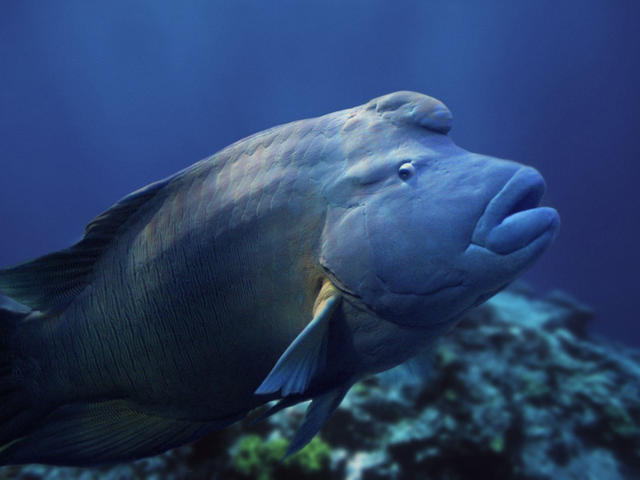


See the source image

Monday, May 28, 2018

Sei Whale


Earlier in the year was whale awareness day and I decided to increase awareness of another type of whale.  It ought to be a matter of concern that only 1/3 of the Sei Whale population is alive since the whaling boom of the late 1800's and early 1900's.  If the world would follow the laws and care about marine life there would be more.
The Sei Whale is a baleen whale.  It is one of the fastest, reaching speeds up to 30-50 mph for short spans.  They are found in all the major oceans of the world, but prefer moderate temperate to warm waters over cold.
Their life span is 50-70 years.
The threats to their species come from commercialized fishing  that threatens their food supply and also where they can collide with large ships and boats and get tangled in fishing gear.  Water pollution, oil spills, toxic chemicals and garbage also are major threats.
The International Whaling Commission is the primary agency that watches and protects this species.  It is also important that consumers only buy seafood that is certified by the MSC (Marine
Stewardship Council) that sets the standards for sustainable fishing.

Friday, March 23, 2018

Blue Whale


Hello, my name is Janna.  I truly love all animals and wildlife, and have always wanted to make a difference in the world in trying to protect and save them.  Yet my heart tilts in a special way towards marine life, so that back when I was in elementary school, in music class I tried to persist in always saying, “My name is Miss Porpoise”.  Being blind, deaf and unable to walk makes it difficult to be as involved and active as I would like in their conservation so I decided to start a blog to educate and encourage others to do so as well. There is strength and power in numbers.  I would like to start with the Blue Whale.
ABOUT THE BLUE WHALE
Blue whales are the largest animals to have lived on Earth, larger than dinosaurs. They can grow to 100 feet long, which is the same as about 3 school buses and weigh up to 200 tons, the same as 33 elephants. Their tongues alone can weigh as much as an elephant. Their hearts, as much as an automobile. 
 Blue whales, which weigh as much as 33 elephants, must eat 4 tons of krill a day. They eat krill, very tiny shrimp like animals, eating up to 4 tons a day by gulping large volumes of water and then letting it back out its mouth through its baleen bristles which hold in the krill while the water goes out.
Blue whales are one of the loudest animals. They give off moans and pulses to communicate that can be heard more than 500 miles away.
They live to be 80-90 years old.  Their age is determined by counting the layers of ear wax.
They were hunted so much in the 1900s by whalers seeking whale oil that they nearly became extinct. They finally came under protection with the 1966 International Whaling Commission, but they still have a way to go to rebuild their population to regard them out of danger.    Words could never encompass the damage of pollution, which majorly threatens our pricelessly dear blue whales. And climate change threatens their population as well because it affects their prey.
We can help by donating to the Great Whale Conservancy: http://www.greatwhaleconservancy.org/
or to Save the Whales at:
and Sea Shepherd Conservation Society at